Fairness will decide how far the energy transition gets
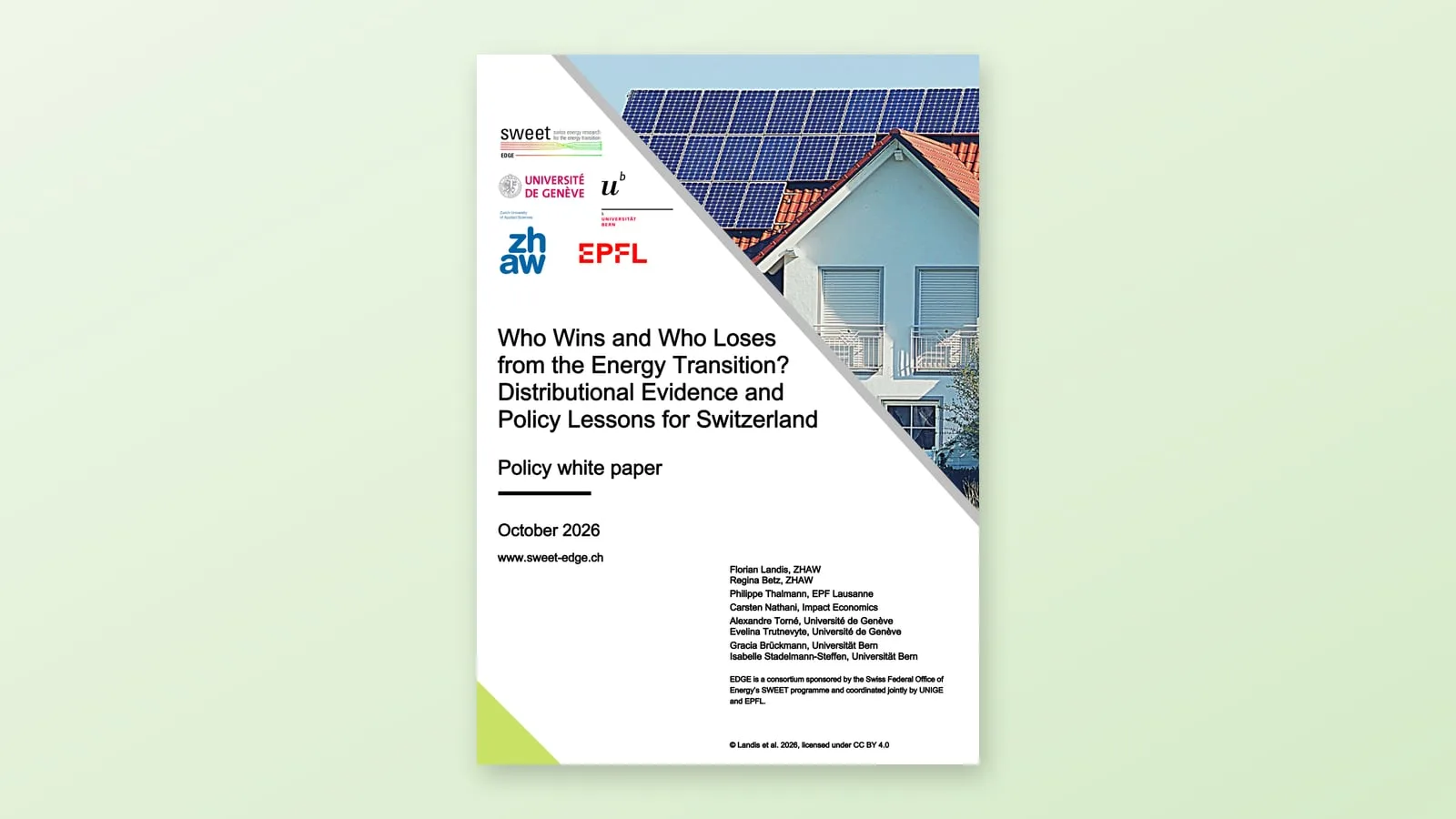
The energy transition is changing how Switzerland produces energy, what households pay and where people work. Who bears the costs, who benefits, and how do people perceive this distribution? EDGE’s third Policy White Paper, “Who Wins and Who Loses from the Energy Transition? Distributional Evidence and Policy Lessons for Switzerland”, brings together four strands of EDGE research to answer these questions and draws lessons for policymakers. It was written by researchers from ZHAW, EPFL, the University of Geneva, the University of Bern and Impact Economics, and was presented today in a ZHAW press release.
More jobs, especially outside the cities. Meeting Switzerland’s renewable electricity targets (35 TWh by 2035 and 45 TWh by 2050) without new nuclear power would create more jobs in building, operating and dismantling power plants than a scenario without these targets. Every canton gains, and economically weaker cantons tend to gain more. The effect is largest in the Midlands (about 0.4% of total employment), followed by the Alps (0.2%) and the cities (0.13%). This potential can only be realised if enough skilled workers are available.
Dynamic electricity tariffs pay off in the long run. Dynamic tariffs reward households for using electricity when it is cheap. In the short term, only a small group of mostly wealthier households would profit, and many would pay slightly more. In the long run, once heat pumps and electric vehicles are widespread, households at all income levels can benefit. For tenants to take part, property owners need to install heat pumps and charging stations. Where up-front costs are too high, “energy-as-a-service” or “rent-to-buy” models can help.
Cleaner homes, uneven burdens. Burning fossil fuels in homes still accounted for 20% of Switzerland’s energy-related emissions in 2023. Combining the cantons’ MuKEn 2025 model regulations (a ban on new fossil-fuel heating, an obligation to install solar panels when renovating roofs, and retrofit obligations for the worst-insulated buildings) with price-based incentives could deliver 35% to 68% more emission savings than purely market-driven investment. But the costs fall unevenly: less affluent households, older people living alone, homeowners, rural households and households in less densely populated cantons risk bearing the greatest burden. Stricter rules forcing investments by 2035 would cut emissions faster, but could strain owners’ finances, public budgets, the workforce and utility revenues.
Visible costs reduce support. In the second SWEET EDGE survey, more than 1,800 Swiss residents gave their views on a ban on fossil-fuel heating and an obligation to retrofit buildings. Support dropped considerably once respondents saw how many tenants and homeowners would pay more or less, and tenants and homeowners reacted in very similar ways. Exemptions or subsidies for households at risk of poverty did not win that support back.
Six recommendations for policymakers
- Make sure enough skilled workers are available where the transition needs them.
- Give all actors the right incentives and information, and align the energy-related interests of property owners with those of their tenants.
- Put framework conditions in place so that low-interest loans, “energy-as-a-service” and “rent-to-buy” offers are available and known to consumers.
- Take differences in impacts into account when choosing policy instruments, as uneven impacts seem unfair and make policies unattractive to voters.
- Compensate vulnerable groups with well-targeted and well-communicated measures, defined broadly enough to include both tenants and homeowners.
- Inform honestly about the remaining differences in impacts and explain why the benefits of the policies justify them.
Read the white paper
The white paper is available in four languages: English, German, French and Italian (PDF). All EDGE white papers are on our Policy Insights page.
Authors: Florian Landis and Regina Betz (ZHAW), Philippe Thalmann (EPFL), Carsten Nathani (Impact Economics), Alexandre Torné and Evelina Trutnevyte (University of Geneva), Gracia Brückmann and Isabelle Stadelmann-Steffen (University of Bern).